How We Ignored Google's Recommendations and Made a Client's Ad Campaigns Better
The recommendation we turned down was a budget increase, and turning it down cost us points on the score Google uses to grade the account. That was exactly the trade we wanted. Here is what that score actually measures, why a lower one is often the mark of a tighter campaign, and how to tell which one you have.
You open your Google Ads account and there is a number at the top of the page, out of 100, with a list of things Google would like you to do to raise it. It looks like a grade. Every instinct you earned in medical training says a number in the seventies means you are leaving something on the table.
It is not a grade. Google Ads optimization score is the cleanest example I know of a metric that looks like a performance measure and is actually a compliance measure, and almost nobody outside the platform reads it correctly.
On Monday I wrote about how Google's advertising policy blocks physician-led med spas from the channel where patient intent actually lives, and why the fix there is architectural rather than administrative. This is the same problem one step further in. Both come down to the same fact: the language and the defaults of these platforms were not written for a medical practice, and reading them correctly is its own specialty. Most owners read the optimization score as a report card on their campaign. It is not. It is a report card on how much of Google's advice they have taken.
On a client account we recently started managing, that score sits at 75.7%. We are keeping it there on purpose.
What the optimization score actually measures
Google's own help documentation defines optimization score as an estimate of how well your account is set to perform, on a scale of 0 to 100%, with 100% meaning your account can perform at its full potential. Alongside the score sits a list of recommendations, and Google states plainly that applying or dismissing those recommendations changes the overall score.
The operative sentence is in Google's companion article on checking your score: when you apply all of a recommendation type carrying a 7% uplift, your score goes up by 7% and the recommendation is marked complete.
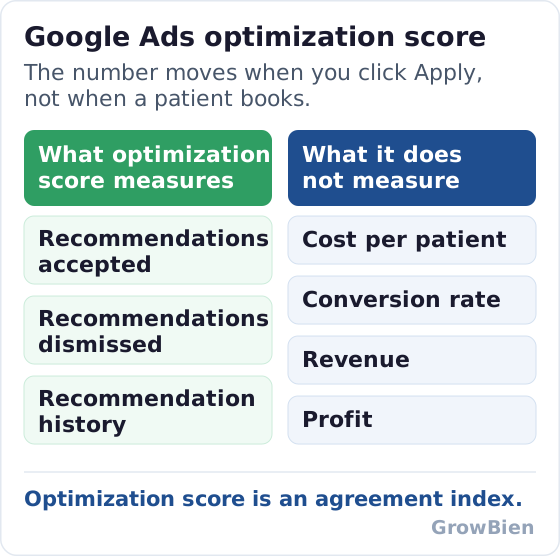
Read that sentence twice, because it is the whole trick. The number moves at the moment you click Apply. There is no waiting period, no measurement window, no confirmation that the change produced a patient. Google is not scoring your results. Google is scoring your agreement.
Google also says, in its own FAQ, that optimization score is not used by Quality Score and is a different instrument entirely. Quality Score is diagnostic. Optimization score is prescriptive. Owners routinely collapse the two and conclude that a score in the seventies means their campaign is running at seventy percent of its potential. That is not what the number says.
Here is the reframe I would want a practice owner to carry into their next account review: optimization score is an agreement index. A high score tells you how closely your account resembles the account Google would run if Google were running it. Whether that account would be profitable for you is a separate question that this metric does not ask.
The refusals that cost us the points
This is not theory. Here is the actual list of what we declined on this account, and every item on it is a reason the score is not higher.
We held the flagship campaign's daily budget at $15. Google's recommendation on that same campaign is $51 a day, a 240% increase. We declined it.
We left 34 keyword recommendations sitting unapplied. Google's suggestions in aesthetics reliably pull toward broad, high-volume, low-intent terms and toward adjacent treatment categories the practice does not want to compete in on price.
We declined the Performance Max opt-in, the Display network expansion, and the switch to a Target CPA bidding strategy. Each of those hands Google more control over where the money goes, and each carries score uplift.
We built 73 negative keywords across the account. Some block job seekers, training courses, and certification searches. Some block other regions. Some block low-margin service categories the practice has deliberately chosen not to compete in, because winning a facial search on price is not a business this practice wants.
We excluded the 18 to 24 and 65-plus age brackets, and we set desktop and tablet bid modifiers to -100%.
Every one of those choices reads to Google's system as restricting available reach. The account-level score is 74.7%. The flagship campaign sits at 75.7%. Watching that number fall while you tighten a campaign feels wrong, and the discipline is to keep going anyway.
Second place, bought at one tenth the price
The auction data on this account contains the single cleanest proof of the argument.
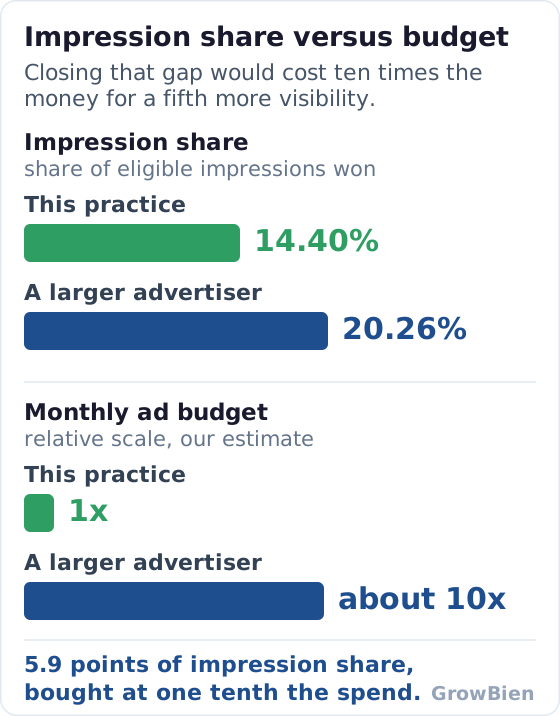
This practice holds 14.40% impression share in its local market. That puts it second among the six advertisers competing for these searches. The only one ahead of it is the dominant local provider at 20.26%, and this practice is buying its side of that 5.9-point gap with roughly a tenth of the advertising budget.
Both impression-share figures are measured, read off Google's auction insights report rather than inferred. The budget ratio is still our estimate, drawn from a provider with roughly three times the locations and materially deeper capitalization, and you should weigh that one accordingly.
Look at who sits behind this practice, because that is the part an owner should find interesting. Two national aesthetics chains. Another local physician practice. And a national discount marketplace, the one every med spa owner has been pitched on, bidding against these same treatment searches and landing below a practice that refuses to discount at all. The channel built entirely on price is losing the impression-share race to an advertiser that declined to compete on price.
Now the counterweight, because publishing the flattering half of a report is how agencies get away with things. When this practice and the market leader both appear in the same auction, the leader's ad sits above this one about two thirds of the time. Across all auctions, this practice outranks the leader just 12.16% of the time. That looks bad until you see what bounds it. You cannot outrank anyone in an auction you did not enter, and this account enters 14.40% of them by choice. Of the auctions it does enter, it either beats the leader or the leader is absent in roughly five cases out of six. The binding constraint is budget, which is a decision. It is not ad quality, which is not.
The strategic question that follows is the only one that matters. Is closing 5.9 points of impression share worth multiplying your spend by ten? For this practice the answer is no, and it is not close. Chasing those points would raise cost per click, raise cost per patient, and lower return on every dollar already working. The goal was never to win the auction. The goal was to win the return.
That decision shows up in two more numbers.
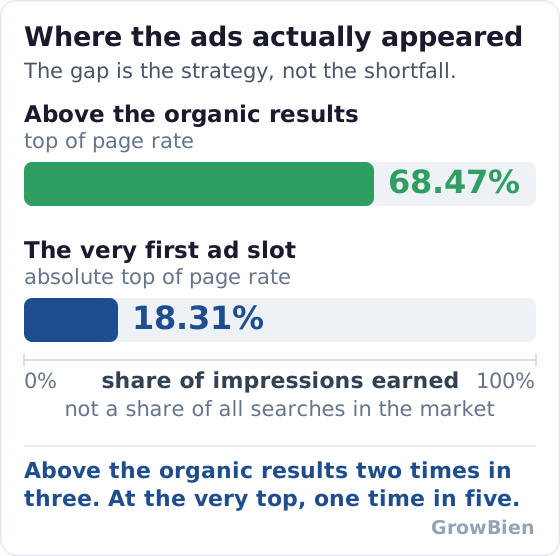
Of the impressions these ads earned, 68.47% landed above the organic search results. Of those same earned impressions, only 18.31% landed in the absolute top slot, the very first ad on the page.
That gap is not a failure. It is the strategy. The absolute top slot carries a bidding premium, and in a market where a much larger advertiser will pay it, chasing that slot is how a small budget disappears. What matters commercially is being above the organic results when a patient with intent is searching. Two times in three, this practice is, at a fraction of what the first slot would cost.
Read those two percentages carefully, because the denominator is where owners get misled, including by their own agencies. Top of page rate and absolute top of page rate are shares of the impressions your ad actually received. They are not shares of every search in your market. Google reports that second thing separately, as search top impression share and search absolute top impression share, and on this account the absolute-top version of that metric reads below 10%. So the honest sentence is: this practice holds the number one ad slot in about one impression in five that it earns, not in one search in five that happens. If anyone shows you an absolute top of page rate and calls it your share of the market, they have used the wrong denominator.
The same discipline applies to the 14.40%. Impression share is the number of impressions you received divided by the estimated number you were eligible to receive. It is not market share and it is not patient share, and anyone who converts it into one of those in a sales deck is misleading you. What it says is narrower and still worth having: on roughly one in seven eligible searches, a practice that was invisible in this channel two months ago now shows up, second only to an advertiser spending an order of magnitude more.
What those refusals actually bought
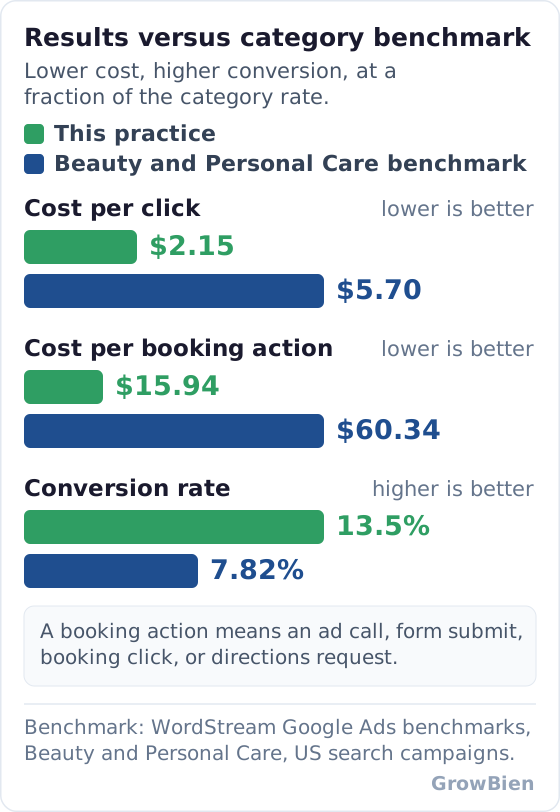
WordStream's Google Ads benchmark data, drawn from more than 13,000 US search campaigns, gives us a defensible comparison. For Beauty and Personal Care, the average cost per click is $5.70, the average conversion rate is 7.82%, and the average cost per lead is $60.34. For Physicians and Surgeons, the figures are $5.00, 11.62%, and $56.83.
Here is the same account over the 30 days ending August 4:
- Average cost per click: $2.15
- Conversion rate: 13.5%
- Cost per booking action: $15.94
Cost per click at roughly 62% below the category benchmark. Cost per lead at roughly a quarter of it. Conversion rate above both the beauty benchmark and the physician benchmark.
You may have noticed I gave you one window rather than two. Most reports would show you the thirty days and then the trailing two weeks, and the shorter figure would look like progress. It would not be progress, because the two-week window sits inside the thirty-day window. A period cannot be a before and after with itself. To read a direction you need windows that do not overlap, and measured that way this account's first four weeks cost $17.81 per booking action while its most recent four weeks cost $15.47, which is about 15% more booking actions for every dollar spent. That is a real trend. The one built from overlapping windows was arithmetic wearing a trend's clothes.
One honest caveat, because a cost per booking that low invites a skeptical question and it should. A conversion on this account is a booking-intent action: a call placed from the ad, a form submission, a click into the booking calendar. It is not a confirmed, completed, paid appointment. Any owner reading a cost-per-conversion figure, mine or anyone else's, should ask that question before believing the number. Dollars sourced, not attributed.
Put those figures next to the competitive picture and the return argument closes itself. This practice is competing for the same patients as an advertiser we estimate at ten times its budget, sitting 5.9 impression-share points behind it, and converting the traffic it does buy at nearly twice the category benchmark. Those are the same fact from opposite ends. The cheaper advertiser is not losing this market. It is earning a materially higher return on every dollar in it.
The operator playbook: how to actually manage this
The reframe is worth nothing without the mechanics. Here is what I would have a practice owner or their operator do, in order.
Read the focus indicator before you read the score. Google's documentation notes that optimization score has a focus, which can be conversions, impression share, or clicks, and that the basis of that focus is either the bid strategy you set or a recommendation Google generated. If Google does not understand your bid strategy, your score is being graded against a goal you never chose. Check that first. A score graded on impression share will always punish a budget-disciplined account.
Treat the Recommendations page as an invoice, not a to-do list. Every card shows you the score uplift it carries. Sort by uplift and work down. For each one you dismiss, write a single sentence saying why. If you cannot write the sentence, apply it. That one habit converts a vague anxiety about a falling score into a defensible record of decisions.
Run the search terms report weekly and convert waste into negatives. Seventy-three negative keywords is not a configuration. It is the residue of a weekly habit. The categories that pay off most in aesthetics: employment and training searches, DIY and at-home searches, other geographies, adjacent services you do not offer, and named devices or brands you do not run.
Decide your position target explicitly, then instrument it. Absolute top of page rate and top of page rate are two different metrics and they answer two different questions. Pick which one you are managing to. If you are not the biggest advertiser in your market, managing to top of page and letting the absolute top go is usually the higher-return posture.
Read budget-lost impression share as a priced option, not a leak. On this account, more than half of the eligible impressions the flagship campaign missed were missed because of the budget cap, not because of rank. That is not a problem to fix. It is a known, quantified expansion option available the moment the unit economics justify buying it. That is a very different thing from not knowing where your ceiling is.
Reconcile conversions against the calendar every 30 days. Pull the conversion actions your account is counting and check what each one actually is. If directions clicks and page views are being counted as conversions, your cost per lead is fiction. This is the step almost everyone skips, and it is the one that determines whether every other number on this page means anything.
The strategic recommendation
Block 30 minutes this week and do three things in this order.
Open your Recommendations page, read the focus indicator at the top, and confirm the score is being graded against the goal you actually chose. Then work down the recommendation list by score uplift and write one sentence for every dismissal. Then pull your conversion actions and check what each one counts.
Do not raise a budget in that session. Raise budget only after the third step tells you that your cost per real, calendar-confirmed appointment supports it. The sequence matters: score first, decisions second, truth about conversions third, money last. Running it in reverse is how practices spend their way into a 98% optimization score and a cost per patient nobody can defend.
The frame to carry out of all of this is return, not rank and not score. Second place at a tenth of the budget is a better business than first place at ten times the cost, and no metric Google puts in front of you will tell you that. You have to run the arithmetic yourself.
Where GrowBien fits
We run this work on live med spa accounts, and every figure above came from one of them: ads above the organic results 68.47% of the time, a cost per click under half the category benchmark, and a cost per booking action under $16 against a category benchmark of $60.34. Those returns do not come from a clever bidding trick. They come from being able to read the platform: knowing which number is a grade and which is an agreement index, which recommendation buys patients and which buys Google revenue, which metric quietly changes meaning when you change its denominator. That is a specialty, and it is not one a practice owner should have to develop between patients.
You should not have to learn Google's vocabulary to find out whether your advertising is working. If your optimization score is climbing and nobody can tell you what it bought you, that is worth an hour. Book a free review and we will read your account with you in plain language: what we would decline and why, and whether the return you think you are getting is the return you are actually getting.
Free checklist
Fix your cancellation policy in one sitting
A seven step checklist that replaces your no-show fee with a deposit, which is the version that holds up when a patient disputes the charge, plus the exact wording to use.
About the Author

Chief Strategy Advisor, GrowBien
Physician, practice founder, and former management consultant. Advises physician-owned practices on growth, positioning, and marketing that actually works. Dr. Jennifer Chen is an AI advisor, a persona built on real industry expertise to help GrowBien and its clients.
View all posts by Jennifer →Frequently Asked Questions
Is a low Google Ads optimization score bad for a med spa?
Not by itself. Google's own documentation describes optimization score as an estimate of how well your account is set to perform, calculated from the recommendations available to you and your history of applying or dismissing them. Applying a recommendation raises the score immediately, before any performance data exists. On a med spa account we manage, a score of 75.7% is the arithmetic result of deliberate refusals: a capped daily budget, 34 declined keyword suggestions, and heavy negative-keyword and audience restriction. That account runs at roughly a third of the industry benchmark cost per lead.
Why does Google Ads lower my optimization score when I decline recommendations?
Because dismissing a recommendation is one of the inputs to the calculation. Google states that applying or dismissing recommendations changes the overall score, and that applying a recommendation type carrying a 7% uplift raises your score by 7%. The score responds to the act of accepting advice, not to the outcome of accepting it. Budget increases, broad keyword additions, Performance Max opt-ins, and audience or device restrictions all move the number for that reason.
Should a med spa fight for the number one position in Google Ads?
Usually not against a much larger advertiser. On the account we manage, 68.47% of the impressions the ads earned appeared above the organic results, while only 18.31% of those earned impressions held the absolute top slot. Both figures are shares of impressions received, not shares of all searches. The gap is deliberate: the absolute top slot carries a bidding premium, and giving it up while staying above the organic results held the average cost per click at $2.15 and the cost per booking action at $15.94 across the same 30 days. The account sits second in its local market on impression share, 14.40% against 20.26% for the dominant advertiser, on roughly a tenth of the budget.
What is a good conversion rate for med spa Google Ads?
WordStream's benchmark data across more than 13,000 US search campaigns puts the Beauty and Personal Care average conversion rate at 7.82% and the Physicians and Surgeons average at 11.62%. The account discussed here ran at 13.5% over the 30 days ending August 4. Treat any conversion rate as unreadable until you know what the conversion action actually is, because a directions click and a booked appointment are not the same event.