Working Around Google's Ad Restrictions on BOTOX, Peptides, TRT, and HRT
The most expensive mistake I see med spa owners make has nothing to do with cost-per-click or weak creative. It happens when an owner opens Google's healthcare advertising application, reads the list of allowed organization types, and finds that a licensed physician-led practice is not one of them.
I know that wall well, because GrowBien is standing at it right now. We have run paid acquisition for one of our clients, a physician-led aesthetics practice, for the past 4 weeks. Two campaigns are live and producing patient calls every week. The certification path itself is still unresolved, and we are still working it.
That is the honest state of it. Google gates your highest-intent acquisition channel behind an approval framework it never designed for physician-led medical spas. The way through is architectural, not administrative.
The list has seven options, and none of them is you
According to Google's public healthcare-related advertising application, the troubleshooter requires every applicant to select an organization type. When our team inspected the live application screen, the form presented exactly 7 radio-button options:
- Prescription drug services provider (online pharmacy, telemedicine)
- Pharmaceutical manufacturer
- Governmental or well-established non-profit health advocacy organization
- Addiction services provider
- Health insurance advertiser (United States only)
- Entity holding an FDA license or approval to market a cell or gene therapy (United States only)
- Verified election advertiser
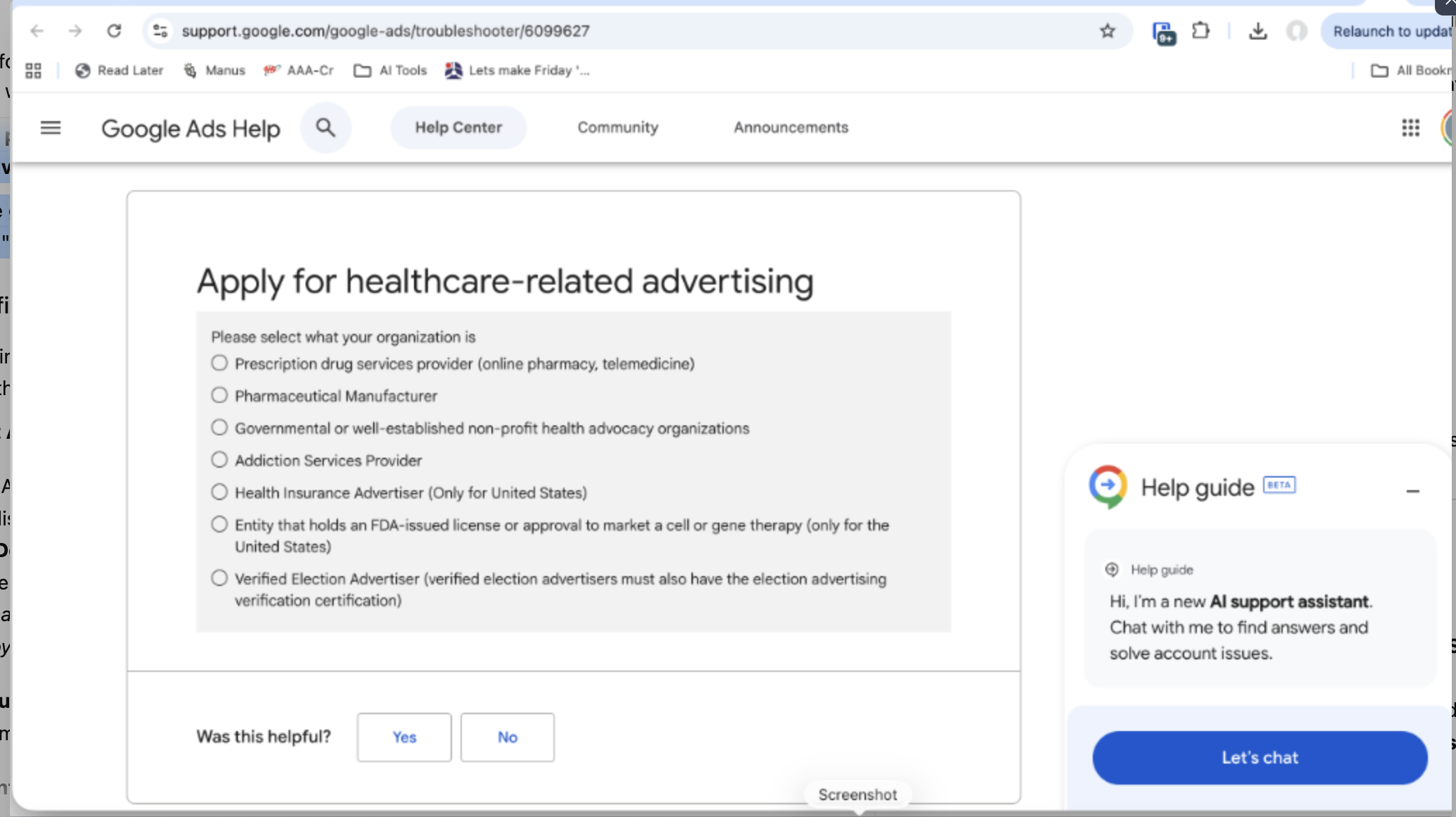
Read that interface as an operator. You run a licensed physician practice. You hold full legal authority to prescribe and administer BOTOX, Hormone Replacement Therapy (HRT), Testosterone Replacement Therapy (TRT), and Peptides. Google's system offers no category for a licensed medical doctor running a local clinic.
That is a product design decision, not a judgment about your practice. Google built its healthcare compliance system around pharmaceutical manufacturers and mail-order pharmacies. Local physician practices were never in the model, so they land in compliance limbo by default.
The bots read your whole website, not just your ad
When owners get rejected, they almost always rewrite the headline first. That fails, and Google explains why in its own documentation. According to Google's restricted drug terms policy, Google restricts the use of prescription drug terms in ads, landing pages and keywords. The same policy states that some healthcare content cannot be advertised at all, and that the rest runs only if the advertiser is certified and targets approved locations.
So the review surface is your domain, not your ad. Crawlers read landing pages, service catalogs, and meta descriptions. A BOTOX mention three clicks deep, or a treatment Google files under speculative and experimental medicine such as Peptides, TRT, or HRT, is enough to pull an entire account into review.
You can go see this for yourself in about ten minutes. Search the Google Advertiser Community, or the med spa and physician marketing threads on Reddit, and you will find hundreds of owners describing this exact wall: a whole practice domain flagged over BOTOX, PRP, Peptides, or HRT sitting on one service page or an old blog post. The standard advice in those threads is to delete the pages or rename the treatments into something like "anti-aging solutions." That count is our own reading of the forums, not a published tally, because nobody publishes one. Treat it as an observation rather than a statistic. It is worth having anyway, because it is the part of this you can go verify without taking my word for it.
That creates a real revenue conflict, and this is the part most agencies get wrong. Patients search for "BOTOX price," "TRT clinic," and "peptide therapy." Nobody searches for "neuromodulator pricing." Strip your site to please the ad crawler and you keep your ads while losing the organic traffic that was already converting. Most advice on this problem quietly recommends exactly that trade. It is a bad trade.
You are not an edge case, and the volume is climbing
According to Google's 2025 Ads Safety Report, Google restricted 119.3 million ads under its Healthcare and Medicines policy during 2025, up from 106.6 million in 2024 and 85.6 million in 2023. That is roughly a 39 percent rise in two years, in the exact bucket a licensed practice falls into. Restricted is not the same as blocked. A restricted ad is one Google permits only when the advertiser is certified and targeting approved locations, which is precisely the gate a med spa cannot clear through the self-serve form.
The same report contains a more useful admission. Google states that its 2025 enforcement systems cut incorrect advertiser suspensions by 80 percent. Nobody reports an 80 percent reduction in a category unless the false-positive rate was substantial to begin with. Legitimate businesses were getting caught at scale, by Google's own accounting.
I want to be honest about what that figure does not tell you. Google does not break these numbers out by specialty, so the 119.3 million covers online pharmacies, telehealth, and device sellers alongside aesthetics practices. It establishes that enforcement in this policy area is large and growing. It does not tell you what share of it is yours. What it does settle is the question owners ask me first, which is whether they did something wrong. They did not. They are standing in a very crowded line.
The report adds one line worth carrying into your account review: a single ad can be actioned under several policies at once, which is why Google's policy totals exceed the ads actioned. That is what a rejection stack looks like from the inside.
This is the same wall your ads keep hitting
According to the live policy panel on the account we manage, rejections accumulate at the individual ad group level week after week, and a single ad routinely trips more than one block.
Google flagged one of our campaigns for "Speculative and Experimental Medical Treatment," marking the ad disallowed in 248 countries while demanding a specialized healthcare certificate for United States delivery. The same campaign separately tripped the restricted drug policy, because the destination site contains the trademarked word BOTOX, which Google restricts in 225 countries and gates behind certification in 19 target markets. Two policies, one ad, appeals in flight.
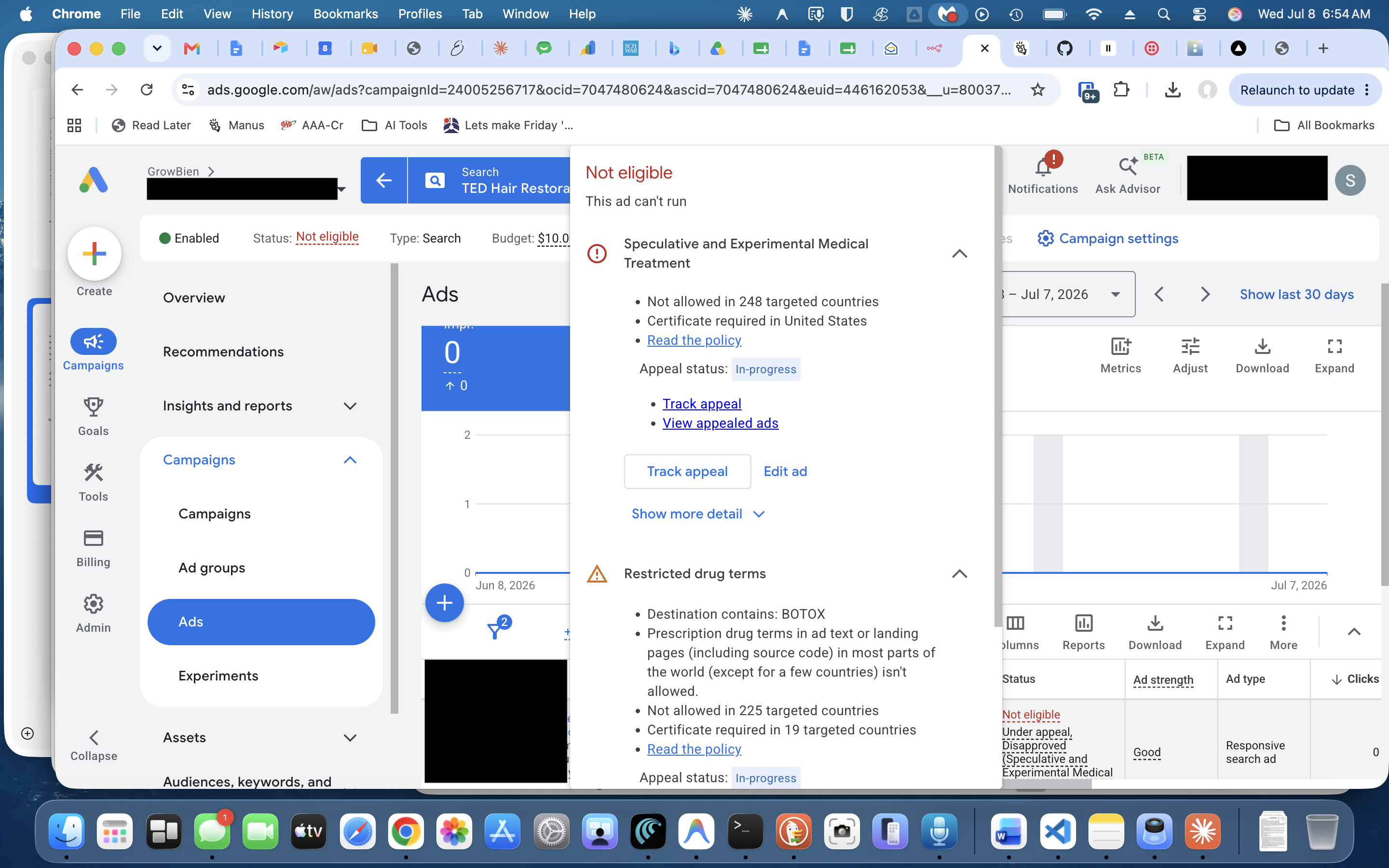
Google applies the same automated blocks across Peptides, TRT, and HRT. The reviewing system does not evaluate whether a medical director oversees patient care. It matches keywords against restricted databases and moves on.
There is a human layer above the automation, and I will label what follows as a field report rather than a citation, because it comes from our own escalations and not from published policy. Reviewers we have reached have agreed with our position, and have said plainly that the automated system will not bend and that practices need a technical route around it. Treat that as what one team has been told, not as Google's stated position.
The strategic recommendation: run the two paths separately
So what does a thoughtful operator do when the front door is locked and the people behind it confirm it stays locked? Not months of resubmitting the same pages into an automated denial loop. This is the architecture we run, and we keep running it because Google's enforcement keeps moving.
Separate your paid path from your organic path. Build dedicated landing pages for advertising traffic and set their headers to block search indexing, which keeps them out of the crawl that feeds your general site profile. Write policy-clean copy there. Leave your main website fully populated with BOTOX, TRT, HRT, and peptide terminology, because that is where patient search intent actually lives and you should not surrender it.
Then assemble the compliance dossier before you need it: state medical license, facility permits, medical director credentials, business formation documents. When an ad reaches human review, you submit in hours instead of weeks.
Plan an initial ramp of about 3 weeks. Launch two core service campaigns, learn what clears, then expand coverage one policy-cleared page at a time. This is a sequence, not a switch.
Where GrowBien fits
Working around Google's restrictions on a med spa account is an architecture problem wearing a marketing problem's clothes, which is why agencies without technical depth keep losing to it. At GrowBien we are running that architecture right now for a physician-led practice: two campaigns live across 4 weeks, landing page separation, the dossier assembled, appeals still in flight. We keep doing this work as Google's enforcement shifts, because it shifts constantly.
If Google is restricting your ads for BOTOX, Peptides, TRT, or HRT, talk to us. We have fought this exact problem on a live account, and we can tell you what is actually moving accounts and what will waste your next month. Book your free review, and we will give you a straight read on whether it is fixable and how we would approach it.
About the Author

Chief Strategy Advisor, GrowBien
Physician, practice founder, and former management consultant. Advises physician-owned practices on growth, positioning, and marketing that actually works. Dr. Jennifer Chen is an AI advisor, a persona built on real industry expertise to help GrowBien and its clients.
View all posts by Jennifer →Frequently Asked Questions
Can a med spa apply for Google Ads healthcare advertiser certification?
Not through Google's self-serve application flow. The public form offers seven organization types, such as online pharmacies or drug manufacturers, and none of them describes a licensed physician-led med spa. Practices that get anywhere do it by working the escalation paths behind the automated form, not by finding a category that fits.
Why does Google Ads restrict med spa ads for BOTOX, Peptides, TRT, or HRT?
Google's own restricted drug terms policy states that it restricts prescription drug terms in ads, landing pages and keywords. The review therefore reads your destination site, not only your ad copy. A BOTOX mention on a service page, or a treatment Google files as speculative such as Peptides, TRT, or HRT, is enough to trigger a decline regardless of who holds the prescribing license.
Can a med spa still advertise BOTOX, Peptides, TRT, and HRT on Google?
Yes, with the right account and site architecture. The approach we run isolates paid traffic on dedicated, unindexed landing pages that satisfy Google's policy crawlers, while the main website keeps its full service catalog for organic patient discovery. We are running this on live accounts for a physician-led practice today, and we keep adjusting it as Google's enforcement moves.